
A short-barreled rifle exists for one reason: it’s easier to handle. It moves through doorways, vehicles, and tree stands without catching on everything, and it shoulders fast. The tradeoff is that a short barrel is loud, flash-prone, and harsh at the muzzle.
That’s exactly why a suppressed SBR makes so much sense. A suppressor adds length, and on a 16-inch barrel, that turns a handy carbine into something long and front-heavy. On a short barrel, the same addition brings the overall package back to a length that still feels wieldy while taming the blast it produces.
It’s also a timely pairing. On October 9, 2026, ATF announced it will not enforce Form 1 and Form 4 approval requirements for individuals making or transferring SBRs and suppressors, removing the wait that used to stand between shooters and this setup. We cover what that means in the last section of this guide.
A short barrel also asks more of a suppressor than a long one does. Here’s what changes, what to look for, and which Dead Air models fit the most common SBR builds.
Why Run a Suppressed SBR?
Handy length. A 10.5- or 11.5-inch SBR with a compact suppressor can land close to the length of a bare 16-inch carbine.
Less blast and concussion. A short barrel hits the shooter and anyone beside them with a sharper report. A suppressor takes the edge off that blast.
Less flash. For law enforcement, military operators, and hunters at dawn and dusk, muzzle flash can hurt night vision and compromise concealment. A well-designed suppressor reduces visible flash as well as sound.
Better communication and control. A lower report makes it easier for teams to communicate, for hunters to stay aware, and for any shooter to focus on fundamentals rather than the muzzle blast.
What Changes When You Suppress a Short Barrel
Backpressure Matters More
A shorter barrel gives the powder less time to burn, so more unburned powder and high-pressure gas end up inside the suppressor and travel back through the gas system. On a gas-operated SBR, that can mean faster bolt velocity, more gas in the shooter’s face, faster fouling, and more wear on parts. That’s why low-backpressure designs matter more when you’re choosing an SBR suppressor than they would on a 16-inch or 20-inch rifle. If you're a hunter that prefers a bolt-action rifle, however, gas regulation isn't quite as critical. As long as your barrel length matches your suppressor's requirements, you can put more emphasis on features like weight, length, and effective suppression.
Durability Should Match Your Firing Schedule
That hotter gas also stresses the suppressor itself. A duty rifle that sees training, qualification, or sustained fire needs materials built for that schedule, while an occasional range or hunting rifle can get by with a lighter option. It's critical to know a suppressor's minimum barrel length restrictions before attaching it to your rifle to ensure all components operate safely and as intended.
Size, Weight, and Mounting
An SBR silencer that’s too long or heavy cancels out the handling you gained from the rifle’s short barrel, so check length and weight with the mounting configuration you’ll actually run. Quick-detach mounts make it easy to move a suppressor between hosts, direct-thread setups are shorter and lighter, and HUB-compatible suppressors let you change mounts later.
5.56 vs. 300 Blackout with a Suppressed SBR
Choosing an SBR silencer starts with the cartridge. 5.56/.223 and .300 Blackout are the two most common SBR chamberings, and they behave differently once suppressed.
5.56/.223 runs at high velocity and high pressure, and short barrels exaggerate that. It’s popular for duty rifles, and it puts real demands on a suppressor in terms of heat, pressure, and durability. A dedicated 5.56 suppressor keeps the profile small and is built around those pressures.
.300 Blackout was designed around short barrels from the start. Its biggest advantage for a suppressed SBR is flexibility between two very different loads:
Supersonic .300 BLK uses lighter bullets traveling faster than the speed of sound. It shoots flatter and carries more energy, which makes it practical for hunting and general-purpose use. The suppressor still reduces muzzle report and flash, but the bullet itself produces a supersonic crack downrange that no suppressor can remove entirely.
Subsonic .300 BLK uses heavier bullets traveling below the speed of sound. With no supersonic crack, a suppressed subsonic load is noticeably quieter overall. The trade-offs are a more curved trajectory and lower energy at longer ranges, so subsonic loads are typically used at shorter ranges.
If you shoot .300 BLK, a .30-caliber suppressor allows you to run both supersonic and subsonic rounds. Just remember that a 5.56-bore suppressor is not a .300 BLK option.
Best Dead Air Suppressors for SBRs
Each of these models fills a different role on a suppressed SBR. Always confirm with the manual for your specific host, barrel, and ammunition.
CT5P: Compact, Low-Backpressure 5.56 Suppressor for Duty SBRs
On a 10.5- or 11.5-inch 5.56 barrel, the CT5P keeps the rifle closest to what an SBR is supposed to be. Its direct-thread configuration is the shortest and one of the lightest 5.56 options in this guide, at 5.49 inches and 13.7 ounces.
The bigger reason it suits a short barrel is gas. The CT5P is optimized for minimal change to bolt velocity on both direct-impingement and piston rifles, and reduces muzzle flash and spark to near-undetectable levels on 5.56 NATO barrels as short as 10.5 inches. Those are the two problems a short barrel makes worse, which makes the CT5P the strongest SBR suppressor in the 5.56 lineup for duty use.
CT5P Specs: 5.49” / 13.7 oz (Direct Thread) | 5.89” / 14.3 oz (Xeno™) | 6.55” / 14.9 oz (KeyMo®) | 1.6” diameter | Haynes® 282® | 5.56 NATO, 6mm ARC | 2,200 ft-lb energy rating | Full-auto rated | No barrel-length restrictions
Best for: Law enforcement and military users running 5.56 SBRs who want the most compact, lightweight, and low-backpressure option for a 10.5- or 11.5-inch barrel.
 Law enforcement officers prefer the Dead Air Silencers CT5P to suppress their SBRs to maintain agility and effectiveness while in the field.
Lazarus 6: Hard-Use 5.56 With HUB Mounting Flexibility
The Lazarus 6 is the 5.56 pick for an SBR that shares a suppressor with other rifles. It’s HUB compatible and offered with Xeno™, KeyMo®, and KeyMo GOV mount capability, so the same suppressor can move from a short-barreled patrol rifle to a 16-inch carbine without rebuilding your mounting setup.
That flexibility adds a little weight. In a Xeno™ mount, it matches the CT5P’s 5.89-inch length but weighs 16.5 ounces. In exchange, you get a Triskelion® Gas Management System designed for minimal backpressure, which helps a short-barreled gas gun stay cleaner and run easier on parts when the firing schedule gets heavy.
See how the Lazarus 6 compares across full-length AR-15 builds in our AR-15 suppressor guide.
Specs: 5.89” / 16.5 oz (Xeno™) | 6.4” / 18.4 oz (KeyMo®) | 6.4” / 18.5 oz (KeyMo GOV) | 1.63” diameter | Haynes® 282® (17-4 PH stainless steel KeyMo GOV adapter) | 5.56 NATO, 6mm ARC | HUB compatible | Full-auto rated | No barrel-length restrictions
Best for: Duty and hard-use 5.56 SBR shooters who want low backpressure and a mount that moves between short and full-length rifles.
Sandman X: Heavy-Duty .300 Blackout SBR Suppressor
For a .300 Blackout suppressed SBR, the Sandman X is the heavy-duty choice. Its .30-caliber bore and 4,200 ft-lb energy rating let one suppressor run both subsonic and supersonic .300 BLK, so you don’t need separate setups for quiet and flat-shooting loads.
On a short host, the mounting detail matters: it ships with a 5/8-24 flash hider, the thread pitch found on many .300 BLK barrels. At 6.4 inches in a Xeno™ configuration, it’s longer than the 5.56 options, so it trades a little length for .30-caliber, full-auto-rated durability.
Specs: 6.4” / 14.5 oz (Xeno™) | 6.9” / 16.8 oz (KeyMo®) | 6.9” / 16.9 oz (KeyMo GOV) | 1.65” diameter | Haynes® 282® | .30 caliber up to .300 RUM | 4,200 ft-lb energy rating | Full-auto rated | No barrel-length restrictions
Best for: Duty users and hunters running .300 BLK SBRs who want one heavy-duty suppressor for both subsonic and supersonic loads.
Wolfman: Modular Option for .300 BLK and Light-Duty Rifle Use
The Wolfman is the next generation of Dead Air’s Wolf-9SD: a 9mm-bore, multi-caliber suppressor built first as a tough subgun silencer and then rated for carbine use. It’s rated for .300 BLK, 5.56, 338 ARC, 7.62x39, 350 Legend, and 357 Mag, so one suppressor can move between a pistol-caliber carbine and a light-duty suppressed SBR in .300 BLK.
Its modular design is a real advantage on a short host. Run it short (5.13 inches, 9.8 oz) to keep your SBR compact, or long (7.5 inches, 14.4 oz) for more sound reduction. Both figures exclude the mount, and the wipe-compatible front cap takes user-replaceable rubber wipes for extra suppression on subsonic loads.
We ship the Wolfman with a 1/2-28 direct-thread mount, but matching your barrel’s thread pitch isn’t the only requirement. For rifle-caliber use, including .300 BLK, we specify a MicroBrake paired with our KeyMicro Adapter (DA451). Confirm the required mounting configuration for your host and ammunition with us before use. Th Wolfman is fully welded with 17-4 PH stainless steel and is full-auto rated, but its rifle role is lighter-duty. For a .300 BLK duty rifle on a demanding firing schedule, the Sandman X is the better SBR suppressor.
Specs: 5.13” / 9.8 oz (short) | 7.5” / 14.4 oz (long) | 1.618” diameter | Fully welded 17-4 PH stainless steel | 2,000 ft-lb energy rating | Full-auto rated | No barrel-length restrictions
Best for: Shooters who want a modular suppressor that covers both a 9mm PCC and a light-duty .300 BLK SBR.
Sierra 5: Compact, Hard-Use 5.56 Option
At 1.5 inches in diameter, the Sierra 5 is the slimmest 5.56 option here, and at 5.72 inches and 13.3 ounces when Xeno™-mounted. On a short barrel, that means less bulk and less weight out front, so the rifle keeps its quick, compact handling.
The Sierra 5’s role is a compact, hard-use SBR silencer with welded Cobalt 6 baffles and HUB-compatible mounting, for shooters who prioritize a small footprint and balanced sound and flash suppression.
Specs: 4.87” / 10.8 oz (no adapter) | 5.72” / 13.3 oz (Xeno™) | 1.5” diameter | Cobalt 6 baffles, stainless steel tube | 5.56 NATO, .224 Valkyrie | 2,200 ft-lb energy rating | HUB compatible | Full-auto rated | No barrel-length restrictions
Best for: 5.56 SBR users who want the slimmest, lightweight hard-use option in a Xeno™ configuration.
Dead Air SBR Suppressor Comparison
|
Model |
Best SBR Role |
Cartridge Focus |
Length / Weight (Xeno unless noted) |
Key Advantage |
|
CT5P |
Duty 5.56 SBR |
5.56 NATO, 6mm ARC |
5.89” / 14.3 oz |
Compact, low backpressure, SOCOM SURG tested |
|
Lazarus 6 |
Hard-use 5.56 SBR |
5.56 NATO, 6mm ARC |
5.89” / 16.5 oz |
Low backpressure plus HUB compatibility |
|
Sandman X |
Heavy-duty .300 BLK SBR |
.30 cal up to .300 RUM |
6.4” / 14.5 oz |
4,200 ft-lb rating, subsonic and supersonic |
|
Wolfman |
Light-duty .300 BLK / PCC |
9mm, .300 BLK, 5.56, and more |
5.13” / 9.8 oz short, 7.5” / 14.4 oz long (excl. mount) |
Modular length, wipe-compatible cap |
|
Sierra 5 |
Compact hard-use 5.56 |
5.56 NATO, .224 Valkyrie |
5.72” / 13.3 oz |
Slim 1.5” diameter, Cobalt 6 baffles |
Suppressed SBRs for Duty Use
For law enforcement and military users, a suppressed SBR is often the most practical patrol or entry rifle. It’s compact enough for vehicles and tight spaces, and a suppressor reduces the concussion and flash that make short barrels difficult to run indoors or with night vision.
Duty use also puts the highest demands on a suppressor. Look for full-auto ratings, materials like Haynes® 282 or Cobalt 6, and gas management that keeps the rifle reliable under sustained fire. Learn more about Dead Air’s law enforcement and military solutions.
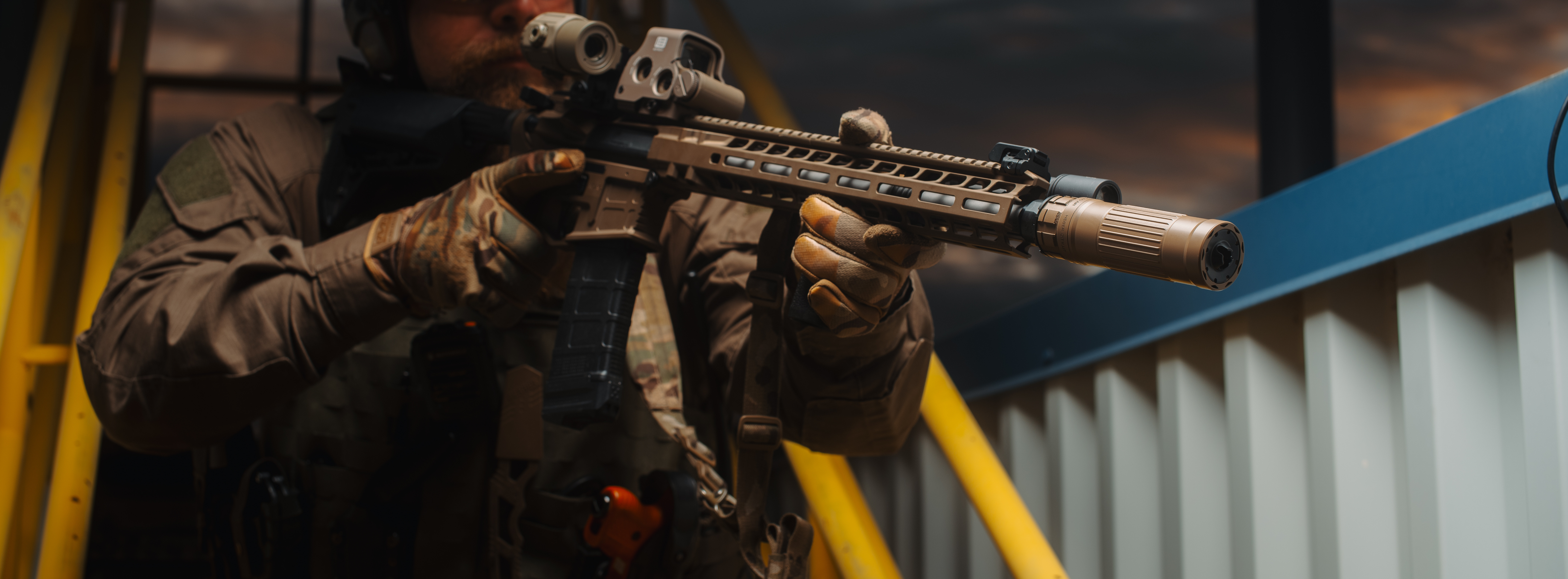 Law enforcement and military operators trust Dead Air Silencers to keep their suppressed SBR running patrol after patrol.
Suppressed SBRs for Hunting
Hunters get many of the same benefits: a short rifle that’s easier to carry through brush and into blinds, less muzzle blast for the shooter and hunting partners, and better situational awareness after the shot. Supersonic .300 BLK with a .30-caliber SBR silencer like the Sandman X is a practical combination for medium game at reasonable ranges. Always check your state’s hunting regulations on suppressor use.
What the October 2026 NFA Change Means
Buying a suppressor used to mean submitting a Form 4, registering it with ATF, and waiting for approval. Under ATF’s October 9, 2026, policy, ATF does not federally enforce Form 4s to transfer a suppressor into your possession, at least for now. Buyers go through a licensed dealer using Form 4473 and a background check, subject to applicable exemptions and state and local law. This is an enforcement-policy change, not a repeal of the NFA, and it could change again. Confirm your state's laws and regulations, and talk with your dealer before you buy.
Find Your SBR Suppressor
A suppressed SBR gives you the compact handling you built the rifle for, with less blast, less flash, and more control. The right model depends on your cartridge, your firing schedule, and how compact you need the final package to be.
Want a broader look at suppressors for full-length AR-15s? See our guide to Dead Air’s Best AR-15 Suppressors.
Find a Dead Air dealer near you to see the CT5P, Lazarus 6, Sierra 5, Sandman X, Wolfman, and the rest of the Dead Air lineup in person.